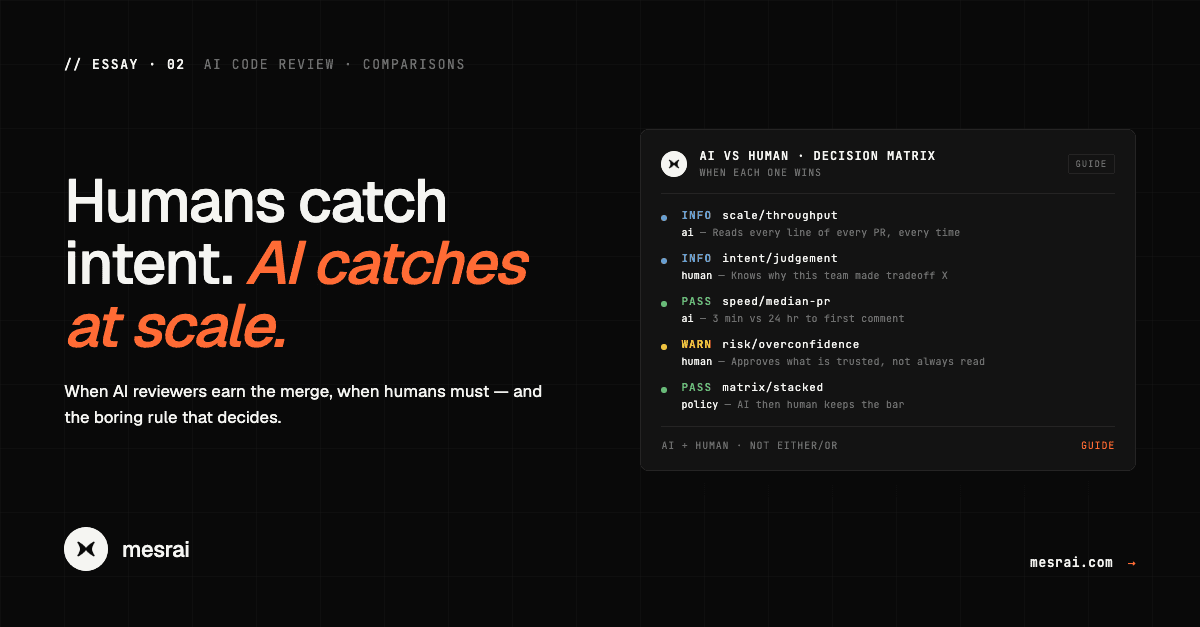
In 2026 the question is not whether AI reviews your code. It is which part of the review you still want a human for, and which part you have stopped fighting. This post lays out the matrix that actually works — based on what we see across teams using Mesrai.
Short version: AI reviews are a throughput layer, humans are a judgement layer. Treat them as alternatives and one of them will burn you. Treat them as complements and most of the friction goes away.
The throughput layer: what AI reviewers are actually good at
AI code review tools — Mesrai included — read every line of every PR, every time, with the same baseline rules applied. A senior engineer reviewing their fourth PR of the day cannot do this. By PR three the eye starts skipping over import order, by PR four the brain stops noticing identifier conventions, and by PR five real bugs sneak through because attention is finite.
Concrete categories where AI consistently wins:
Style and consistency. Naming conventions, file structure, formatting. A reviewer that never gets tired beats one that does.
Mechanical bug patterns. Off-by-one, unhandled null, missing await, unsanitized input concatenation. These have signatures.
Cross-file impact within a PR. A function renamed in one file, still imported by an old name in another. Trivial for tooling, expensive for humans on a 30-file diff.
Documentation drift. Public API changed, README still says the old signature.
None of this is what your senior engineer wants to do at 11 pm.
The judgement layer: what humans still own
AI reviewers, including the ones with deep repo context, cannot answer two questions reliably: should this exist, and is this the simplest version of it. Both are judgement calls that require taste, team history, and an opinion on what the codebase wants to be.
Categories where human review still wins:
Architectural fit. Does this new abstraction belong, or are we adding a layer because someone read a blog post?
Product judgement. Is this the right edge case to handle, or are we engineering for a request that came from one customer once?
Team conventions. "We don't do that here" — codebases have culture, and AI does not feel it.
Inter-team coordination. This change will conflict with the migration the other team is mid-flight on. AI cannot know that.
Speed: where the median PR actually sits
Across the teams we work with, the median time-to-first-review on a human-only workflow is around 24 hours. With Mesrai or a similar AI reviewer wired in, the median time to first comment drops to about three minutes — and that comment now flags the style nits, the import order, the missing test, the unhandled null path.
The senior reviewer then arrives the next morning to a PR that has already been through one pass. They review the architecture, not the missing semicolons. Two things happen: the PR ships faster, and the human review is sharper because the noise is gone.
Where this falls apart: stacking, not parallelizing
The most common failure mode we see: teams treat AI review as a replacement for one of the two human reviewers required by the merge policy. The AI approves, one human approves, the PR merges. Bugs slip through that neither caught — and the post-mortem blames "the AI."
The fix is not better AI. The fix is to stack AI as a pre-review pass that humans still gate. Mesrai posts findings, the author addresses them, then a human approves. The human is reviewing a cleaner PR — not approving the AI's verdict.
The risk humans bring: over-confidence
Senior reviewers approve what they trust. That sounds fine until you measure how often they actually read every line of a PR from someone they trust. The honest answer is: not often. The PR from a junior gets four comments and 40 minutes of attention. The PR from a tenured staff engineer gets a thumbs-up in 90 seconds.
AI review does not get tired of someone's tenure. It reads the staff engineer's PR with exactly the same rigor as the junior's. This is unglamorous and unflattering to senior engineers — and it is also the single highest-value thing AI brings to a mature team.
The decision matrix
Use this when wiring up review for a new repo or team:
Scale-driven categories (style, consistency, mechanical bugs, cross-file impact within a PR) → AI handles in seconds, every PR. Mandatory.
Judgement-driven categories (architecture, product, conventions) → at least one human reviewer, mandatory.
High-blast-radius changes (auth, payments, schema migrations) → both AI and a senior human, no exceptions, no fast track.
Trivial changes (typo fix, copy update, version bump) → AI only is fine; let the policy match the risk.
What this looks like in practice
A 40-engineer team we worked with shifted to this matrix and saw median time-to-merge fall from three days to 14 hours over six weeks — without removing the human reviewer requirement on anything that mattered. The AI absorbed the volume, the humans absorbed the judgement.
The phrase we now use internally: AI is a force multiplier on review attention, not a substitute for it.
How to think about choosing a tool
If you are evaluating Mesrai specifically: we built it around the assumption that AI handles the throughput layer and humans own the judgement layer. The product never auto-merges, never auto-fixes without your approval, and never pretends to know your product. It catches the boring 70% so your senior engineers can focus on the 30% that needs a brain.
That boundary is the entire point. If you find a tool that crosses it — sets itself up as the gatekeeper — be careful. The throughput layer is valuable. The throughput layer pretending to be the judgement layer is how teams get burned.
TL;DR
AI catches at scale. Humans catch intent. Run both, in that order, and the bar holds.