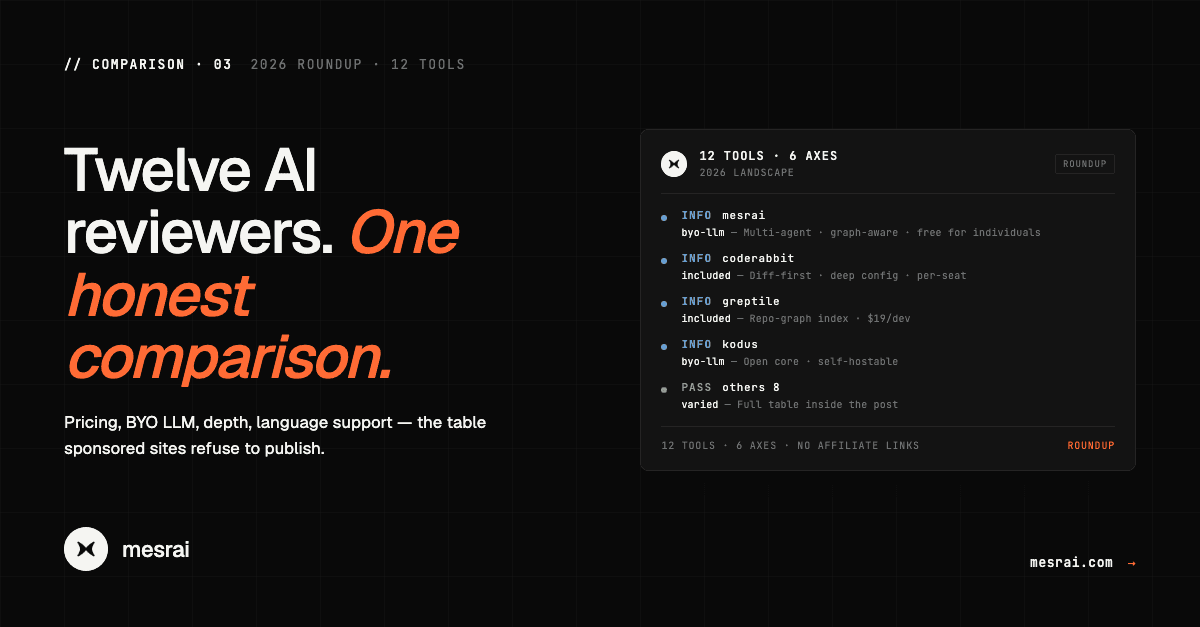
The AI code review market grew from three serious players in 2024 to over twenty in 2026. Most of them are good. A few are excellent for specific use cases. None are universal. This is the honest comparison — no affiliate links, no "sponsored placements," just what each tool actually does and who should pick it.
How we picked the twelve
From the wider set, we kept tools that meet four criteria: (1) actively maintained in 2026, (2) used by at least one team we know personally, (3) supports at least three major languages, (4) does not require you to leave your existing PR surface to read findings.
The axes of comparison
Pricing model — included LLM vs bring-your-own-key.
Review depth — diff-only vs repo-graph context.
Speed — median time from PR open to first comment.
Language coverage — number of supported languages with first-class rules.
Team controls — severity, rule packs, per-repo policy.
Honest gotchas — what the marketing pages skip over.
1. Mesrai
BYO LLM key by default. Multi-agent review (security, performance, architecture, style) that loads your repo as a graph before evaluating the diff. Free for individuals, paid per seat for teams. Posts inline on GitHub, GitLab, Bitbucket, Azure Repos.
Best for: teams that already have an Anthropic or OpenAI account and want architecture-aware review without paying twice for the LLM.
Honest gotcha: documentation is improving but lighter than the larger competitors.
2. CodeRabbit
Included LLM, per-seat pricing. Deep configuration surface — finest-grained rule control of any tool on this list. Diff-first analysis with cross-file context for larger PRs.
Best for: large teams that want to lock down the review policy across many repos.
Honest gotcha: per-seat pricing scales steeply past 50 engineers.
3. Graphite Reviewer
Included LLM, tightly integrated with Graphite's PR-stack workflow. Fast model, terse comments, low noise. Strong on TypeScript and Go.
Best for: teams that already use Graphite for stacked PRs.
Honest gotcha: locked into Graphite as the PR layer; weaker outside that ecosystem.
4. Greptile
Included LLM, $19 per developer. Indexes the whole repo as a graph and queries against it during review. Strong cross-file analysis.
Best for: monorepos and large codebases where context across files actually matters.
Honest gotcha: first index of a large repo can take an hour.
5. Kodus
Open core. BYO LLM key. Self-hostable for teams with strong data residency needs.
Best for: regulated industries, sovereign deployments.
Honest gotcha: self-hosting means you also own the upgrade path.
6. Qodo Merge (formerly PR-Agent)
Open source core, included or BYOK options. Strong test-coverage and security analysis. Wide language support.
Best for: open-source projects that want CI-driven review.
Honest gotcha: the open-source edition lags the hosted product by 1-2 minor versions.
7. Sweep
Crosses the boundary — both reviews and offers auto-fix PRs. Included LLM. Best on Python and JS.
Best for: teams who want auto-PR generation alongside review.
Honest gotcha: auto-fix PRs require careful policy or you get noise.
8. CodiumAI / Qodo Cover
Test-focused. Reviews and also generates tests for uncovered code paths. Included LLM.
Best for: teams with coverage targets and a CI pipeline that can ingest auto-test PRs.
Honest gotcha: generated tests need pruning — same risk as any AI-written test.
9. Codacy (AI mode)
Long-standing static analysis tool with AI review layered on top. Strong language breadth.
Best for: enterprises already using Codacy for static analysis.
Honest gotcha: AI mode feels bolted on; depth is shallower than purpose-built tools.
10. Bito
Included LLM, free tier. Mix of IDE-side suggestions and PR review.
Best for: individual developers who want one tool for both editor + PR.
Honest gotcha: less proven on large team rollouts.
11. Korbit
Included LLM, learning-oriented. Comments are written to teach the author, not just flag.
Best for: teams onboarding juniors who benefit from explanatory feedback.
Honest gotcha: more verbose than senior engineers prefer.
12. CodeAnt AI
Strong India presence, BYOK options, security-first rule packs.
Best for: teams that need compliance-leaning security review.
Honest gotcha: security depth at the cost of architecture analysis.
How to choose
Three honest filters that narrow the field fast:
Do you already pay for an LLM? If yes, BYOK tools (Mesrai, Kodus, some Qodo plans) save you 60–80% vs included-LLM pricing at scale.
Do you have a monorepo? Pick a tool with repo-graph indexing (Mesrai, Greptile).
Do you trust auto-fix? If no, avoid tools that default to it (Sweep). If yes, gate it behind a flag.
The takeaway
There is no "best" AI code reviewer in 2026. There is best-for-this-team, and the table above is the closest you will get to picking without a trial. Most of these tools have free trials. Run two or three side by side for a week before committing.